The Economics of Quiet
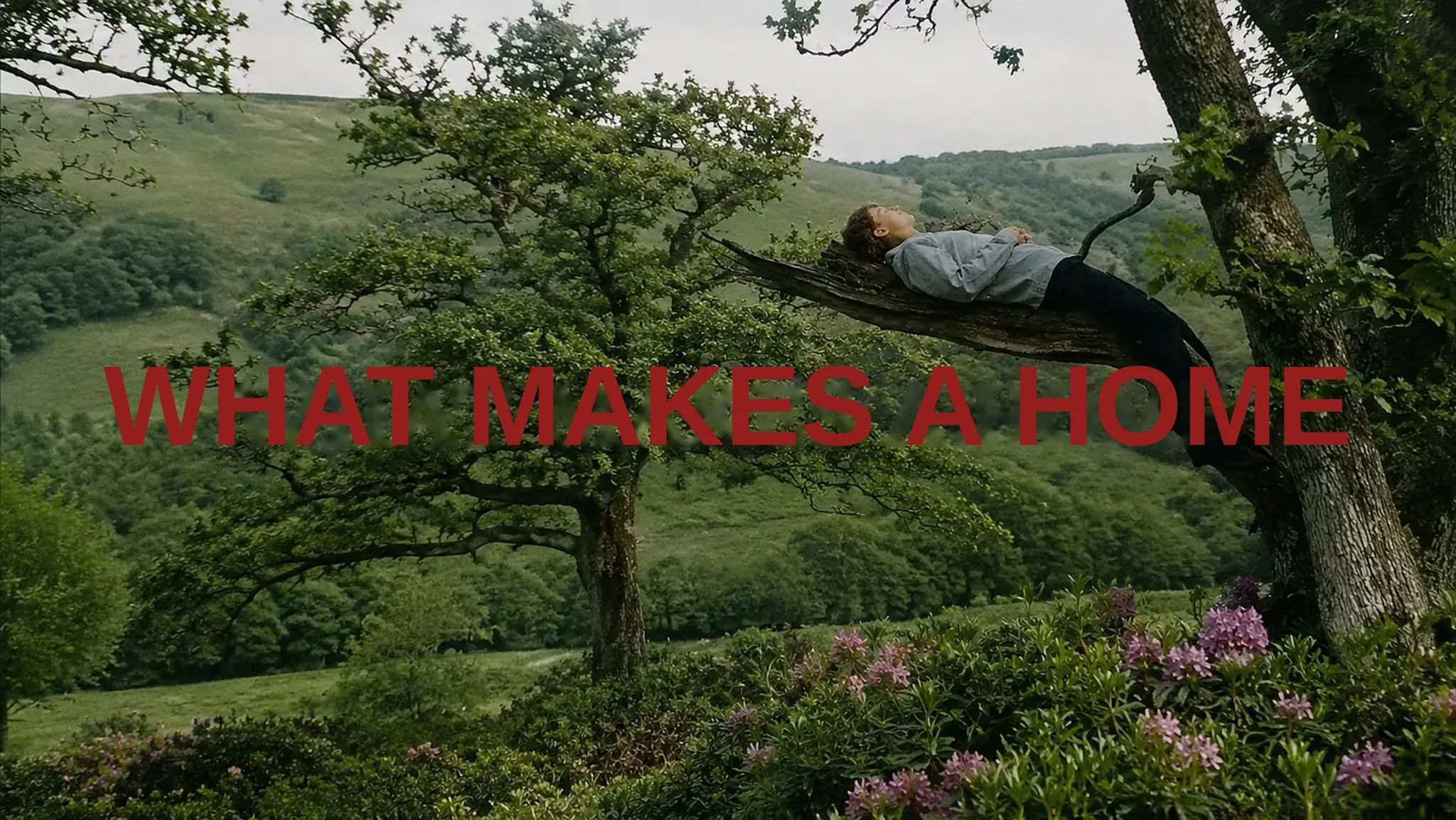
What makes a home.
By Tanya Teterina
There is a sentence circulating in marketing decks right now that would have sounded absurd a decade ago: presence is the new luxury, silence is the new status symbol. Behind the metaphor sits an entire pricing strategy. According to a global study by McKinsey & Company, “The Future of Wellness trends,” mental well-being, quality sleep, and mindfulness have firmly established themselves as top priorities for consumers worldwide. Analysts note that people’s willingness to pay for such products is growing at an accelerated pace. This ultimately transforms silence and “attention hygiene” from abstract spiritual values into measurable market indicators.
Which raises the question this piece actually wants to sit inside: if silence is now for sale, what exactly is being sold? Not the absence of sound. What’s being sold is an alternative to something older and harder to manufacture — an internal point of stability that used to come from somewhere else entirely: from a place you belonged to, a home whose rituals you didn’t choose but inherited.
Home as a Point of Stability
But what is home? We make a fundamental mistake when we define “home” by geography or a property deed. Home is a temporal structure, not coordinates in space.
Psychologically, it functions as a metronome, pacing out the chaotic noise of the outside world. Home imposes a rhythm on existence: a domestic sequence that pieces the day together. Once absorbed beneath the skin, this rhythm becomes our internal gyroscope. In this modern era of constant displacement, the physical walls themselves may be lost in a move, but the rituals and the objects that anchor us will survive any change of address.
There is not a drop of sentimental nostalgia in this. Nostalgia is a museum of the lost; it is sterile and always backward-looking. Here, rituals act not as memory, but as defensive fortifications for the present. Any irrational, repeated household act is a trench that the nervous system hastily digs amid the chaos to reclaim control and a sense of safety. This is precisely what is so desperately needed here and now.
This is why the deficit of stability has become today’s most expensive commodity. The market instantly detected this existential hunger and began selling a simulation of presence. And though a brand cannot sell you your childhood kitchen — since selling lived years is a different kind of alchemy — they will gladly sell you an ersatz: a candle scented like a “hearth,” a weighted blanket, or a pre-packaged “wind-down script.” You are being sold a flawless anchor. Even if it lacks the depth of time required to actually hold a ship steady in a storm.
A Brief, Deliberately Small Word on Why This Isn’t Really About Politics
Watching how deftly the market monetizes this vulnerability, it is easy to default to righteous anger against the system itself. It feels as though the noise and the peddling of surrogates are a uniquely modern capitalist sin. As Columbia University professor Jonathan Crary brilliantly argues in his work “24/7: Late Capitalism and the Ends of Sleep,” modern capitalism actively seeks to eliminate every pause, quiet moment, and even sleep itself, simply because a silent or sleeping person cannot consume.
But therein lies the trap: the historical evidence doesn’t support a clean systemic split. While capitalism’s noise is commercial (attention monetized, novelty as a business model) — actually-existing socialism was not, in practice, quiet either. It simply replaced commercial noise with ideological noise: collective meetings, public loudspeakers, and the moral demand to always be visibly productive.
The quiet that Soviet citizens did carve out came from neither system’s design. As cultural historian Svetlana Boym documents in “Common Places: Mythologies of Everyday Life in Russia,” this coveted quiet was built over tea on the communal kitchen floor — the only “island of safety” where private life could survive through whispers and inherited rituals because the public sphere had been almost entirely occupied by the state.
This suggests something more useful than a political diagnosis: quiet is not a feature any economic system hands you. It is something people build privately, in spite of whichever system they are in. That is the real starting point for what follows, because it means the responsibility (and the opportunity) sits with individuals, households, and brands.
Three Generations, Three Different Rituals Against the Same Noise
This is where the story becomes especially interesting for brands. The hunger for quiet is nearly universal, but the ritual each generation reaches for is not. The same noise calls for three very different antidotes.
Gen Z builds quiet by disappearing. Having grown up without an unmonitored offline world, Gen Z instinctively seeks fewer points of contact. Surveys consistently show young adults deliberately limiting screen time, muting notifications, switching phones to grayscale, or replacing smartphones with “dumb phones.” The goal is cognitive relief. Their version of quiet is architectural as much as digital: a closed door, noise-canceling headphones, Do Not Disturb mode, a phone that asks less rather than offers more. Silence, for Gen Z, is achieved by subtraction.
Millennials build quiet through curation. Unlike Gen Z, who simply disconnect, Millennials tend to turn calm into a worldview. Slow mornings, intentional consumption, locally roasted coffee, linen bedding, organic wine, analog notebooks — none of these objects creates silence. Together, they become its vocabulary. This is why quiet luxury naturally evolved into something broader: quiet living. Calm has become an aesthetic, a moral preference and, inevitably, a social signal. For Millennials, silence is carefully composed.
Boomers build quiet through continuity. Their idea of calm is less about disconnecting than about returning: to familiar streets, familiar neighbors, familiar routines. If younger generations search for silence by reducing inputs, Boomers often find it by preserving what already feels dependable. For them, home is quieter not because it is technologically simpler, but because it holds accumulated memory. The neighborhood restaurant where everyone knows your name or the same grocery store. Continuity itself becomes a form of quiet.
What This Means If You’re Building a Brand, Not Just an Aesthetic
What we are witnessing is three generations navigating the exact same crisis through entirely different strategies. One chooses isolation, another curates, and the third seeks continuity. The scripts may vary, but the underlying deficit of stability is universal.
The ultimate mistake is treating quiet as a universal mood board: beige walls, linen curtains, a single lit candle — and assuming this sterile aesthetic resonates equally across the board.
The reality is far more nuanced. A twenty-two-year-old is looking for relief from radical, non-negotiable accessibility. A thirty-eight-year-old is looking for coherence between what they value and what they consume. A sixty-four-year-old is looking for continuity in a world that changes faster every year.
And that completely rewrites the playbook for building a brand.
We have long described brands as expressions of identity. Increasingly, however, the organizations people actually return to play a more visceral role: they function as anchors — small, predictable coordinates of orientation in an unstable world. They earn that place only by becoming part of the quiet, daily rituals people rely on to regulate their nervous systems.
The strategic question is:
“Which ritual of stability can our brand authentically support?”
Because strip away the trend reports and the marketing charts, and you are left with a very simple thing. It is the search for a psychological home. A place, a ritual, a relationship, or a brand that simply says: you are safe here.
© DADÔMU Narrative Studio